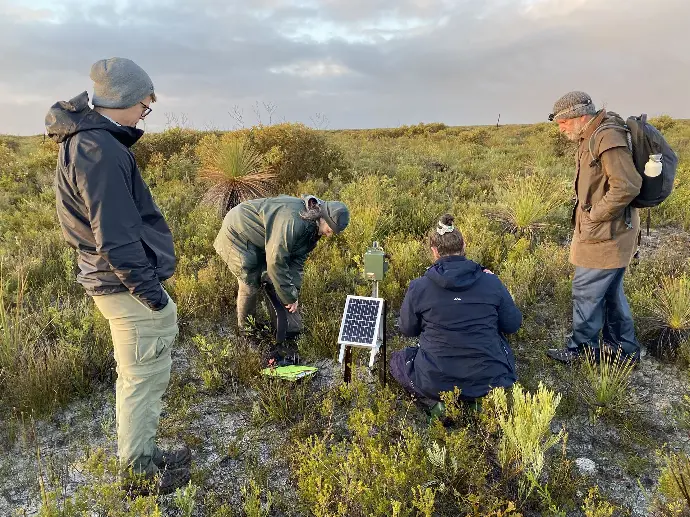
Threatened Species Survey Guidelines
Developing best practice field survey guidelines and recommendations for threatened species monitoring
The EMSA modules are designed to provide specific instructions for conducting field surveys for a broad range of ecological attributes. However, they do not offer bespoke surveys tailored to particular species.
DCCEEW, in collaboration with TERN, undertook a review of the 110 priority threatened species identified in the Threatened Species Action Plan 2022-2032 to gather existing knowledge on the survey methods typically implemented by practitioners experienced in monitoring these threatened species. A workshop was held to bring together expert knowledge, and literature overviews (70 species) and literature reviews (40 species) were compiled.
By making information on survey methods more readily available, we can move towards ensuring all monitoring is species-appropriate, comparable between practitioners and populations, and repeatable over time. Further, together with consistent terminology, guidelines, instructions, and data collection, we can refine efforts and resources to measure and share information. Data collected using robust, standardised methods will improve our knowledge of threatened species and underpin threatened species recovery at scale.
The literature reviews document and assess the survey techniques known to work and identify opportunities to standardise the methods. The documents are learning resources and should be used by practitioners to identify best practice field survey guidelines and recommendations for species of interest. The documents will be reviewed over time as survey methods are refined, more information is shared, and new technologies become available. Please contact EMSA if you have feedback.
Literature reviews
Literature reviews are available for 40 of the 110 priority threatened species identified in the Threatened Species Action Plan 2022-2032. The literature reviews provide a summary of monitoring typically conducted, along with information on the species ecology and biology that help inform on the best practice monitoring methods, techniques, and survey timing. The documents have been reviewed by invited practitioners experienced in monitoring the species.
Click below to access the literature review documents. The documents are intended to be updated regularly as new information becomes available. To provide feedback, please complete the form below.
Literature overviews
Literature overviews have been prepared for 70 of the 110 priority threatened species identified in the Threatened Species Action Plan 2022-2032. The literature overviews provide a high level summary of monitoring typically conducted. The documents have been reviewed by invited practitioners experienced in monitoring the species.
Click below to access the literature overview documents. The documents are intended to be updated regularly as new information becomes available. To provide feedback, please complete the form below.
Survey Guidelines
This document outlines recommendations for the minimum data-related information to record when conducting monitoring surveys for priority threatened species. Information is recorded to document:
- site location, including the context of the wider project area, surrounding land uses and land tenure
- habitat of the site, including vegetation composition and structure attributes, soil and rock substrate, refuges and resource availability
- condition of the site, including historical and current disturbances, as well as ongoing disturbances related to development activities
- timing of the surveys, and the survey effort undertaken
- skills and experience of the survey personnel
- specific monitoring methods, techniques, and equipment used
- results of the monitoring
- data access and availability, and data custodian contact details, specifically where researchers or anyone interested in the data can find the dataset.
Download the Survey Guidelines document.
Guidelines Workshop
The Threatened Species Monitoring Guidelines Workshop was held on the 27th August 2023.
Species experts, ecologists, and researchers involved in monitoring threatened species, particularly the 110 Priority Threatened Species listed in the Threatened Species Action Plan 2022-2032, were invited to attend the online workshop.
Aims of the workshop were to:
- Introduce the ‘Standardising survey guidelines for priority threatened species monitoring’ project, outline the scope and goals of the project, and how the project aligns with the Ecological Monitoring System Australia (EMSA).
- Describe the work already underway and what we know so far.
- Identify opportunities to standardise best practice monitoring methods for taxa groups and individual species.
- Ensure that the people and organisations with expertise in monitoring priority threatened species have the opportunity to contribute to this project.
The workshop recording is available for viewing.
Acknowledgements and Contributions
Workshop Contributors
The following people are thanked for their contributions during the workshop:
Aggie Stevenson, Alanna Chant, Alexandria Thomsen, Allan Burbidge, Amelia Cook, Amy Coetsee, Amy Koch, Andrew Baldwin, Angela Gardner, Annette Rypalski, Ashley Leedman, Ben Zeeman, Bruce Chessman, Kerry Cameron, Carl Gosper, Carly Lambert, Carly Steen, Catherine Young, Chantelle Doyle, Chris Jolly, Chris Ormond, Chris Palmer, Cindy Hull, Claire Hartvigsen-Power, Clare Hawkins, Courtney Etherington, Dan Edwards, Dan Harley, David Newell, Denise Bond, Deon Utber, Dianne Brown, Eleanor Velasquez, Ellen Kilpatrick, Elroy Au, Emily Rush, Eren Delgado, Fiona Marshall, Frances Daniels, Gael Glassock, Geoffrey Heard, Giles Young, Gillian Walker, Golo Maurer, Grainne Maguire, Harry Moore, Hedley Grantham, Ian Radosavljevic, Iona Flett, Jacinta Hendriks, Jacqui Richards, Jemina Stuart-Smith, Johanne Martens, Juanita Renwick, Julie Quinn, Karen Hermon, Karrena Veltman, Kate Umbers, Katerina Grypma, Kathryn Schell, Katie Irvine, Kelly Dixon, Kerryn Herman, Kym Blechynden, Kym Ottewell, Lainie Berry, Leonie Valentine, Lindy Lumsden, Lisa Wood, Luke Smith, Lyndel Wilson, Malcolm Kennedy, Maree Treadwell Kerr, Mark Laws, Tim McGrath, Melissa Broadway, Michael Magrath, Michelle Drew, Mike Craig, Nancy Auerbach, Naomi Indigo, Nick Gellie, Nicolas Rakotopare, Paul Barden, Peter Lacey, Pratik Vhatkar, Rachel Paltridge, Rachel Swain, Rebecca Diete, Roy Teale, Russell Palmer, Sally O'Neill, Sarah Barrett, Sarah Brown, Stewart Huxtable, Talitha Moyle, Tanya Llorens, Tayla Lawrie, Tegan Douglas, Toby Patterson, Tom Le Breton, and Sandra Walpole.
Literature Review and Literature Overview Contributors
After the workshop, the draft Literature Overviews and Literature Reviews were made available for review. All reviewers are thanked for the contributions made and are acknowledged in the respective documents.
Provide feedback